
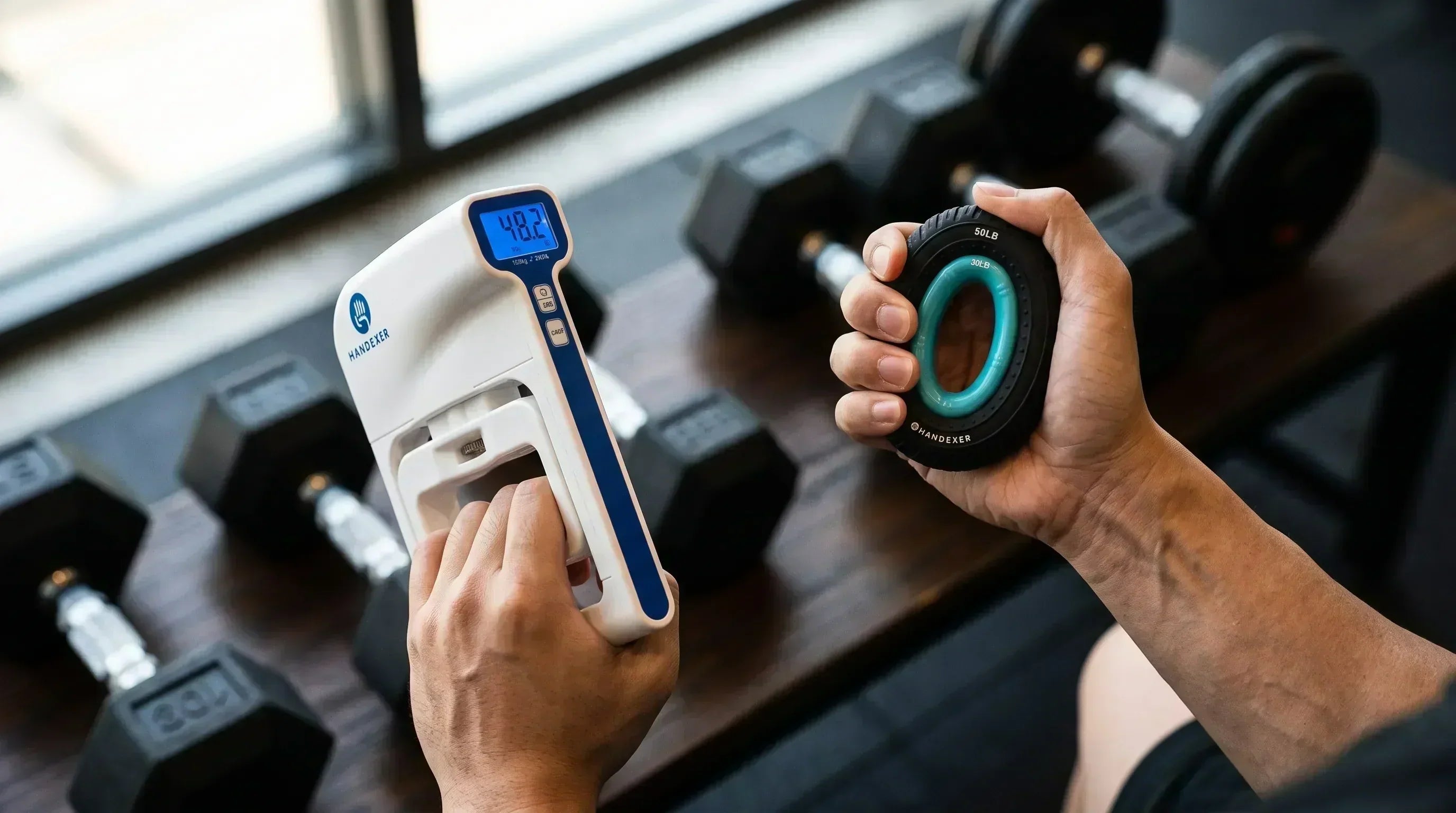
⚡ Quick Summary: Understanding the 3 Types of Hand Grips
Think of your hand as a complex multi-tool rather than a single clamp. Exercise science and biomechanical literature categorize hand grip into three distinct modalities:
- Crush Grip (The Squeeze): The dynamic closing power of your fingers against your palm. Driven by forearm flexor muscles, it is what you use when shaking hands or squeezing a standard hand squeezer exercise tool.
- Pinch Grip (The Precision Clamp): The force generated strictly between your thumb and fingertips without touching your palm. Heavily reliant on the small intrinsic muscles inside your hand, it is critical for climbing crimps and grabbing weight plates by the rim.
- Support Grip (The Static Hold): The endurance of your fingers hanging onto a static handle over time. Essential for holding heavy deadlifts, farmer’s carries, or carrying heavy grocery bags without dropping them.
Biomechanical Breakdown: How Your Hand Generates Force
In their classic research text Biomechanics of the Hand (1989), scientists established that hand movement relies on relies on 34 individual forearm and hand muscles executing complex lever mechanics across 29 bones. Rather than treating "grip" as a single muscle output, isolating its three mechanical forms prevents training plateaus and targeted muscle imbalances.

| HAND GRIP MODALITIES | ||
|---|---|---|
| CRUSH GRIP (Dynamic Squeeze) |
PINCH GRIP (Thumb-Finger Clamp) |
SUPPORT GRIP (Static Hold) |
| Primary Drivers: FDS & FDP | Primary Drivers: Intrinsic & FDP | Primary: Flexor Group |
| Vector: Inward Squeeze | Vector: Compressive Pinch | Vector: Static Resistance |
1. Crush Grip (Dynamic Squeezing Power)
Crush grip represents the dynamic action of closing your fingers toward your palm pad and squeezing tightly.
An EMG muscle-activation analysis published in the Journal of Hand Therapy (2001) demonstrates that dynamic closing power relies heavily on two extrinsic forearm flexors:
- Flexor Digitorum Superficialis (FDS): Actively flexes the proximal interphalangeal (PIP) joints (the middle knuckles).
- Flexor Digitorum Profundus (FDP): Pulls the distal interphalangeal (DIP) joints (the fingertips) shut.
Everyday Analogy: Crushing a soda can, squeezing a calibrated hand squeezer, or giving a firm business handshake.
Key Exercises: Dynamic hand squeezer exercises, calibrated grippers, and thick cable handle squeezes.
2. Pinch Grip (Thumb-Opposed Clamping)
A biomechanical muscle-activity study published in the Journal of Neurophysiology revealed that over 60% of pinch stability is generated by intrinsic hand muscles—specifically the Thenar muscle pad at the base of your thumb and the Interossei muscles between your metacarpal bones.
-
Three Common Pinch Types:
-
Tip Pinch: Thumb tip to index/middle fingertip (precision work).
-
Key (Lateral) Pinch: Thumb pad pressed against the side of your index finger (turning a key).
-
Wide Pinch: Open-hand pinching across thick surfaces (gripping a weight plate rim).
-
-
Everyday Analogy: Opening a glass jar, turning a stubborn key, or holding a climbing hold.
3. Support Grip (Isometric Holding Endurance)
Support grip is your hand's ability to maintain a fixed hold under continuous gravitational pull without letting your fingers roll open.
A muscle fatigue kinetics study published in Applied Ergonomics measured forearm muscle behavior during static holding tasks. Their EMG analysis confirmed that support holding fails primarily from localized fatigue in static forearm flexors and wrist stabilizers.
Everyday Analogy: Holding a heavy deadlift, lugging suitcases, or hanging from a pull-up bar.
Key Exercises: Heavy farmer's walks, dead hangs, and prolonged isometric grip exercises.
Comparison Matrix: Crush vs. Pinch vs. Support
| Feature / Metric | Crush Grip | Pinch Grip | Support Grip |
|---|---|---|---|
| Action Type | Dynamic Concentric Squeeze | Precision Compressive Clamp | Static Isometric Hold |
| Primary Muscle Driver | FDS & FDP (Forearm Flexors) | Intrinsic Hand & Thenar Group | Forearm Flexor Group & Wrist Stabilizers |
| Thumb Involvement | Secondary (Passive Wrap) | Primary Structural Driver | Secondary Hook Support |
| Primary Limiting Factor | Peak Dynamic Force Output | Intrinsic Hand Fatigue & Skin Friction | Neuromuscular Holding Endurance |
| Scientific Benchmark | Peak Dynamometer Squeeze | Pinch Block Maximum Hold | Time-to-Fatigue at 70% Max Load |
The 2-Minute Grip Weakness Self-Diagnostic
Follow these 3 quick checks to pinpoint your primary hand bottleneck:
Once you've identified your primary bottleneck, you can test your peak force and see how your squeezing numbers rank against age and gender standards using our Free Grip Strength Percentile Calculator ↗.
Targeted Hand Grip Workout Routine & Protocols
1. Crush Grip Protocol: Building Squeezing Power
-
Rated Hand Gripper Closes: 3 sets × 5–8 reps per hand. Position a calibrated hand squeezer exercise gripper across your palm. Execute an explosive 1-second squeeze, then control the opening for 3 seconds. Rest 90 seconds.
-
Thick Cable Handle Squeezes: 3 sets × 8–10 reps. Attach a fat-grip handle to a cable machine for smooth progressive overload.
2. Pinch Grip Protocol: Intrinsic Thumb-Finger Power


- Wooden Pinch Block Lifts: 4 sets × 10–15 second holds. Pinch a wood block with thumb and finger pads only; lift and hold statically.
-
Plate Rim Pinches: 3 sets × 15–20 second holds. Pinch the rim of two smooth weight plates together with fingertips only.
3. Support Grip Protocol: Enhancing Holding Endurance

- Heavy Farmer’s Carry: 3 sets × 30–45 seconds. Walk tall with heavy dumbbells; keep shoulders retracted and wrists neutral.
-
Double-Overhand Static Hang: 3 sets to near-failure. Hang from a pull-up bar using a full double overhand grip (no hook grip, no straps). Accumulate 90–120 total seconds.
How to Measure and Track Your Progress
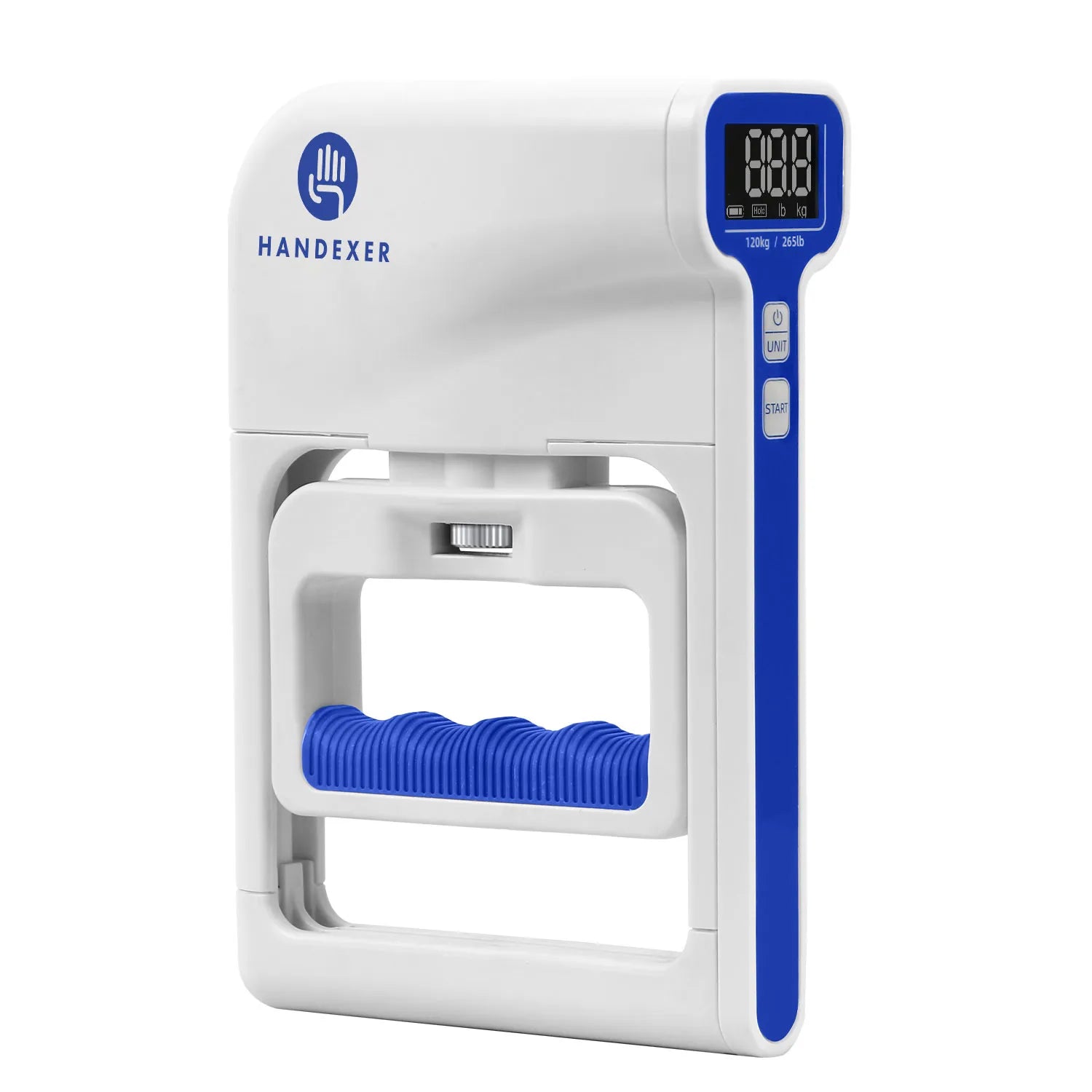
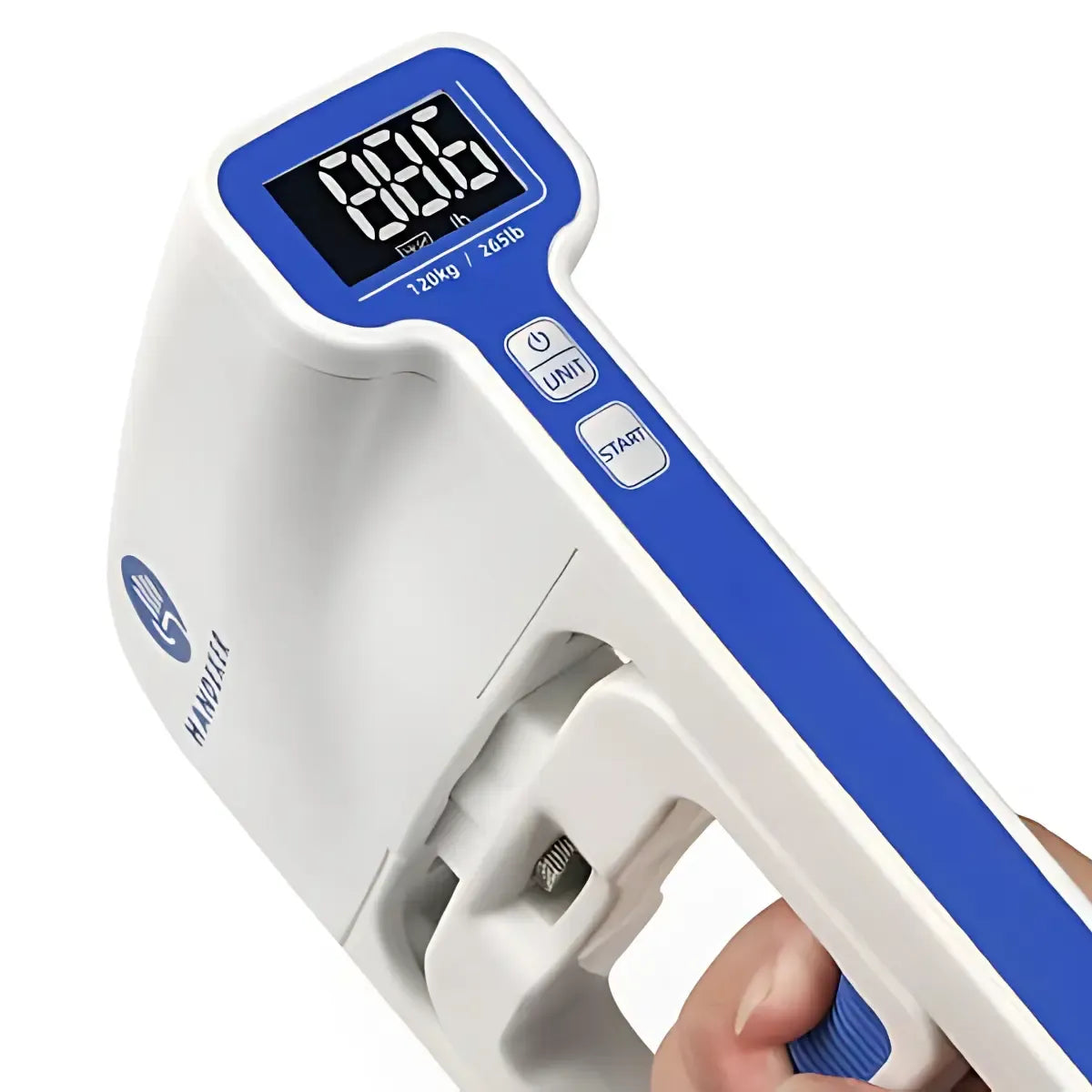
Standardized clinical recommendations from the American Society of Hand Therapists (ASHT) mandate testing with a digital dynamometer to confirm progressive overload:
- Posture: Sit upright with shoulders relaxed, elbow flexed at 90°, and wrist in a neutral posture.
- Protocol: Execute three 3-second maximal squeezes on a digital dynamometer. Rest 60 seconds between attempts for full muscle ATP recovery.

💡 Tip: Wondering what your raw squeeze force actually means? A 45kg squeeze means something completely different for a 20-year-old male athlete versus a 50-year-old female beginner. You can plug your raw dynamometer score into our Online Grip Strength Calculator ↗ to see your exact force percentile.
Common Grip Training Mistakes to Avoid
- Relying Solely on Cheap Spring Grippers: Spring grippers only build Crush Grip. They miss the thumb opposition needed for Pinch Grip and the static stamina required for Support Grip.
- Bending Your Wrists Forward: Curling your wrist forward during heavy holds reduces flexor leverage and increases carpal tunnel strain. Keep wrists neutral or slightly extended.
- Training Maximum Effort Daily: Forearm flexors fatigue rapidly under maximal strain. Limit high-intensity grip sessions to 2–3 times per week to allow proper tendon recovery.
Frequently Asked Questions (FAQ)
Q1: If my goal is a heavier deadlift, can I just train with standard spring grippers?
Answer: Not effectively. Standard spring grippers primarily train Crush Grip (dynamic closing power), whereas deadlifts require Support Grip (isometric holding endurance under heavy load). To stop dropping heavy barbells, prioritize heavy farmer’s carries, axle holds, and double-overhand static hangs.
Q2: Why does my grip strength plateau so quickly compared to big lifts like bench or squat?
Answer: Hand and forearm muscles are smaller, denser in fiber composition, and involved in almost every daily task. They recover quickly from light fatigue but overtrain easily under daily maximal squeezes. Limit high-intensity grip work to 2–3 sessions per week, allow 48 hours of recovery, and check your force score on our Grip Strength Percentile Tool ↗ to ensure structured progressive overload.
Q3: My dominant hand is 15% stronger than my non-dominant hand. Is this normal?
Answer: Yes. Clinical research by the American Society of Hand Therapists (ASHT) shows most people have a 10%–15% force discrepancy favoring their dominant side. If the gap exceeds 20%, start your unilateral sets with your weaker hand first, and match that volume with your stronger hand.
Q4: What's the difference between Pinch Grip and Crimp Grip in rock climbing?
Answer: Pinch Grip requires active opposition from your thumb pad against your fingertips across a surface. A Crimp Grip relies purely on hyper-flexing your finger joints against a small edge, usually without thumb opposition. Pinch training builds intrinsic hand muscles (thenar group), while crimping loads flexor tendons and finger pulleys.






Share:
How to Build a Grip Strength Plan for Different Ages and Sexes
How to Test Grip Strength at Home Accurately: Step-by-Step Guide & Norms